Movie Summary
The first film gives the background context for the characters, but viewers can still enjoy this film without watching the first Fantastic Beasts. Grindelwald, the antagonist in the film, is set to face trial before he escapes. His goal is to build an army and reshape the wizarding world, posing a threat to both the magical and non-magical worlds. Newt, the expert on magical beasts and creatures, is called into action by Albus Dumbledore and has to find Credence, a mysterious mage from the first Fantastic Beasts instalment.
The resulting story follows Newt as he unites with old allies, forms new alliances, and looks for Credence in the pursuit to stop Gellert Grindelwald. A gripping adventure, it continues the same humor and charm of the first Fantastic Beasts film, and gives fans of the Harry Potter Wizarding World more intriguing lore to throw themselves into.
Genre and Storytelling Approach
The main themes of the film are fantasy and adventure, retaining the magical wonder of the Harry Potter world. Though it entwines darker tones than the first film, with concepts of ideological conflicts, testing loyalty and identity, and creating a more mature and layered narrative.
The narrative has a more complex design too, with multiple perspectives, shifting focuses between characters and subplots, and tying these in a broader narrative arc. It can feel fragmented or even dense at times, and there are no slow-burning acts for the audience to soak in what's happening. However, with lighthearted humor and vivid magical events, Crimes of Grindelwald does not alienate viewers.
Cast and Performances
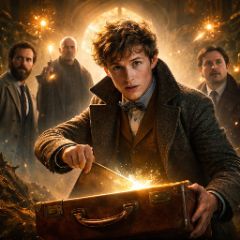
As a branch of one of the most famous film series in cinema history, the expectations for Crimes of Grindelwald was high, and the production team delivered. The film features an ensemble cast of many well-known actors, as well as a few recurring faces from the first instalment of the franchise.
Eddie Redmayne returns as Newt Scamander, embodying the quirky and relatable magizoologist. Johnny Depp returns as Gellert Grindelwald, delivering a calm yet menacing presence as the mysterious antagonist. Katherine Waterson returns as Tine Goldstein, the ally and potential love interest of Newt.
Albus Dumbledore, a key character who links this franchise to the original Harry Potter series, is portrayed by Jude Law, acting as a young Dumbledore. Finally, The Crimes of Grindelwald sees the return of Ezra Miller as Credence Barebone, a wizard with a mysterious background who was the main antagonist of the first Fantastic Beasts film.
Key Highlights
One of the film’s standout elements is its visual design. From the streets of Paris to the intricate, magical settings, the world-building remains immersive and detailed. The special effects and creature designs continue to expand the Wizarding World in visually compelling ways.
Another highlight is the exploration of moral ambiguity. Rather than presenting a simple good-versus-evil dynamic, the film delves into ideological conflicts, particularly through Grindelwald’s rhetoric. This adds a layer of complexity that encourages viewers to question motivations and perspectives.
The film also introduces major plot revelations that reshape the broader narrative. These twists aim to deepen the mythology, though they sparked mixed reactions among audiences due to their unexpected nature.
Final Thoughts
Fantastic Beasts: The Crimes of Grindelwald is an ambitious sequel. It expands the scope of the Wizarding World while embracing a darker and more intricate storyline. Its strengths lie in its performances, visual spectacle, and thematic depth, with a more complex narrative structure than the first Fantastic Beasts film, as explored on Film & Pop Culture Insights.
Entertainment Supporters